
‘Reaction to Fire’ Vs ‘Fire resistance’
This article looks at two important test criteria for passive firestop solutions
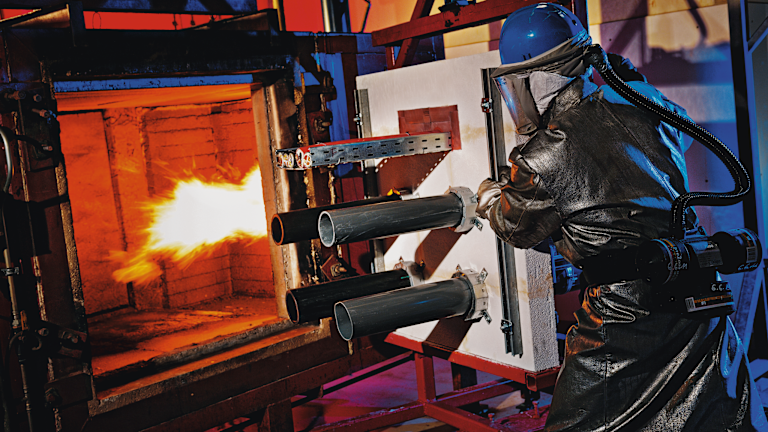
The difference between reaction and resistance for fire stopping
National building regulations for passive firestop in Europe define general rules of building construction and levels of required fire protection per type of building. They also define rules relating to firestop systems and compartmentation details and sometimes contain inspection and enforcement procedures and fire testing methods.
Two important fire testing methods for through penetration systems refer to ‘reaction to fire’ and to ‘fire resistance’. This can lead to misunderstanding or confusion for engineers, architects or planners when writing generic or performance specifications or defining firestop systems to be used in fire compartments. There is, however, an important distinction between the two.

Picture 1: firestop products and tests on fire resistance
What is reaction to fire?
If a fire is able to find sufficient flammable materials it will quickly spread through an area. It is therefore crucial to use materials of limited combustibility. Reaction to fire testing evaluates a construction material’s contribution to fire, mainly by assessing their level of combustibility. It is the response of a product in contributing by its own decomposition to a fire to which it is exposed, under specified conditions. This is a pure material response, product-oriented criterion.
The European standard “EN 13501-1: fire classification of construction products and building elements� provides a number of performance criteria to measure the fire characteristics of building products. Materials and products can be classified into 7 different Euro classes according to the way that they react to fire. Based on the test results, standard products are divided into 7 main classes: A1, A2, B, C, D, E and F. Besides the level of combustibility, the standard also defines additional classes according to the amount of smoke developed (s1, s2 or s3) and the amount of burning droplets or particles generated (d0, d1 or d2).
The implementation of these so called ‘Euro classifications’ took many years, but these fire standards and classifications are now well-known and accepted by the whole European building industry.

Figure 1 shows a summary of the definitions of the different classes according to EN13501-1.
Special additional rules do exist. For example class A1 cannot be combined with other classes, classes A2 – D are always combined with s and d classes and class E may exist on its own or may be combined with an additional class for burning droplets.
The reaction to fire class of a firestop product is always mentioned in a European Technical Assessment. It is stated in the chapter about “characteristics about performance of the product and references to the methods used for its assessment�.
What is resistance to fire?
Fire resistance is a through-penetration system’s ability to resist the passage of fire through a wall or floor in a fully developed fire situation and prevent temperature rise between the exposed and unexposed sides. Resistance to fire for a firestop system is measured according to two criteria:
E – Integrity. Capacity of the product to prevent the passage of fire and hot gases. No breakthrough of flames is permitted.
I – Insulation. Capacity of the product to prevent the temperature increase to the non-exposed side of a wall or floor. It is the limitation of heat radiation to an ambient temperature (not more than 140° C above ambient as an average measurement and no more than 180° C at any one location).

Figure 2: the two test criteria in EN1366-3 testing: integrity and insulation
If one of the above criteria is exceeded, the test is terminated and the duration achieved prior to failure will dictate the appropriate fire resistance classification.
The standard fire resistance rating values are 15, 30, 45, 60, 90, 120, 180 and 240 minutes according to EN13501-1. This rating typically means the period during which a passive fire protection system / construction element can withstand a standard fire resistance test.
In contrast to the purely material-oriented reaction to fire criterion, the resistance to fire is a system-oriented measurement, referring to a construction element, meaning that the entire element should resist the impact of fire. A combustible material, as part of a complete firestop system, can therefore feasibly achieve fire resistance ratings.

Picture 2: A full-scale system test is conducted in a fire resistance test set up
With º£½ÇÉçÇø, engineers and planners are on the safer side
Reaction to fire tests need to be conducted to classify the combustibility of a product. Firestop systems, though, need to contain a fire as per the building compartmentation strategy. Therefore, fire resistance ratings need to be achieved for specific fire-rated walls or floors.
Besides the technological challenges, º£½ÇÉçÇø, with own world-class research, development and testing is committed to supply easy-to-use firestop solutions and provide cutting-edge and fully integrated and tested systems. When combined with unique professional technical support in many countries, this helps specifiers and installers to correctly select the right system for the right application and also to properly specify compliant and tested solutions.